
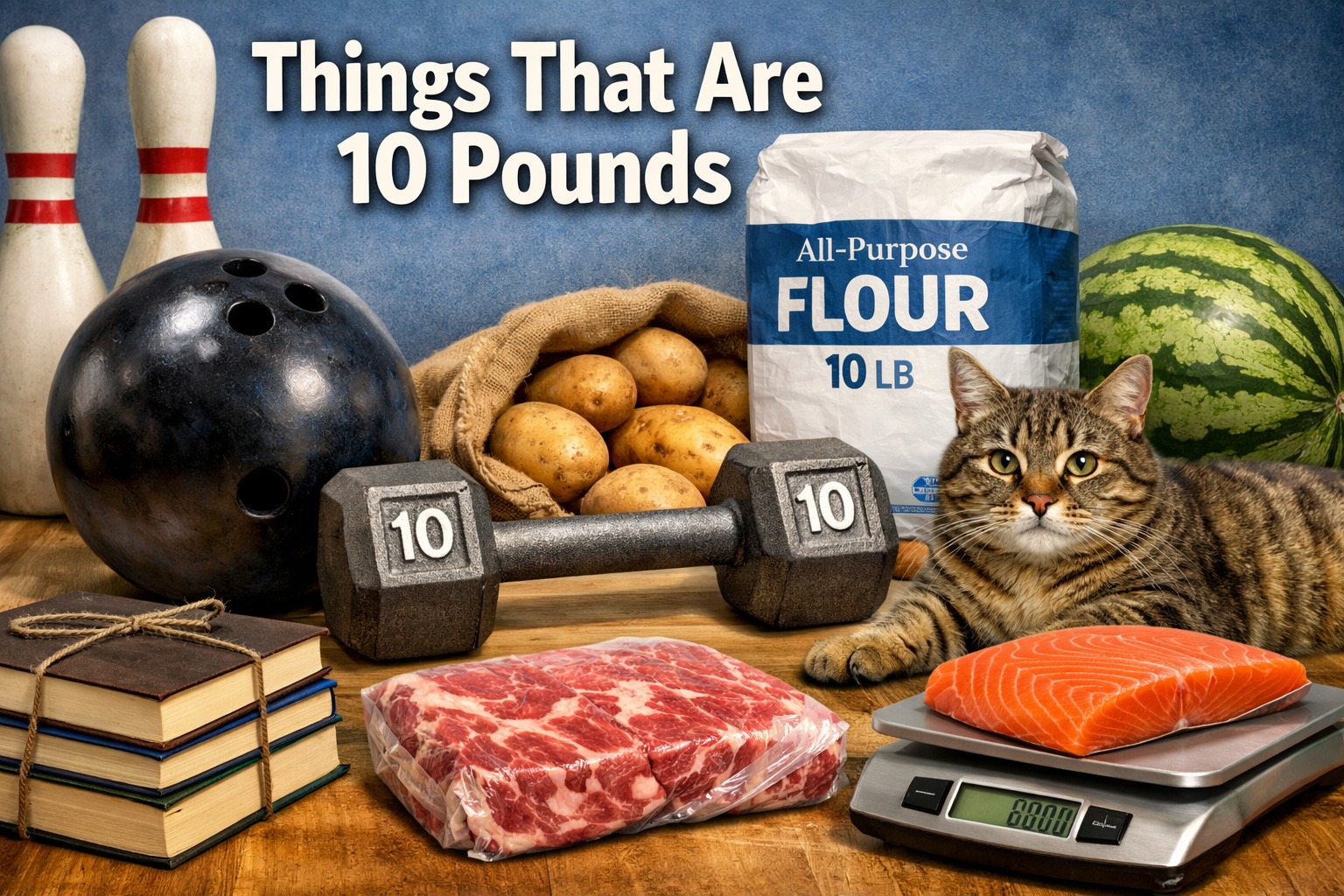
Numbers feel clean and precise, but weight rarely does.
Most people hear “10 pounds” and think they understand it. In reality, that number means very little without context.
Weight becomes real only when it connects to something you have held, carried, or struggled with. Ten pounds can feel light in one situation and surprisingly heavy in another. Shape, balance, movement, and time all change how your body experiences the same number.
That is why everyday comparisons matter. They turn abstract measurements into something your brain can picture instantly.
Below is a clear, human-friendly breakdown of things that weigh about 10 pounds. Each example uses a different kind of object so you can feel the difference, not just read about it.

Large House Cat
A large adult house cat often weighs close to 10 pounds.
This is one of the easiest ways to picture the number.
When you lift a cat, the weight feels compact but alive. It presses into your arms while shifting slightly. Even calm cats adjust their position, which makes the load feel more demanding than it looks.
Ten pounds in this form feels manageable, but not weightless. After holding a cat for a few minutes, your arms start to notice the effort. That slow fatigue makes this comparison very realistic.
If you have ever carried a cat from one room to another, you already know what 10 pounds feels like.

Car Tire
A small car tire weighs around 10 pounds, without the rim attached.
The weight itself is not extreme, but the shape changes everything.
A tire spreads its weight across a wide circle. There is no natural handle, so your hands work harder to control it. Even though it weighs the same as many smaller items, it often feels heavier.
This example shows how awkward objects demand more effort. Your muscles strain not because of weight alone, but because of poor grip and balance.
Ten pounds can feel much heavier when the object fights your hands.

Check This Out: 13 Things That Weigh 1 Gram You’ll Never Guess
Bag of Potatoes
A standard grocery bag of potatoes commonly weighs 10 pounds.
This is one of the most accurate and familiar references.
The weight feels dense and steady. Nothing shifts inside the bag. When you lift it, gravity pulls straight down with no surprises.
This type of load feels honest. Your arms know exactly what they are dealing with. It does not wobble, roll, or resist.
If you have ever carried groceries into your kitchen, this comparison locks in immediately. It represents a clean, no-nonsense version of 10 pounds.

Sugar Bags
Many large sugar bags also come in 10-pound sizes.
They look smaller than potato bags, but they hit just as hard.
Because sugar packs tightly, the weight feels concentrated. The bag stays firm and compact, which makes it easier to hold but not lighter.
This is a good reminder that size does not equal weight. A smaller object can feel just as heavy when all the mass sits in one place.
Ten pounds of sugar proves that density matters more than appearance.

Watermelon
A medium watermelon often weighs close to 10 pounds.
Some fall slightly under. Others push past it.
Unlike bags or boxes, a watermelon is round and slippery. You cannot grip it easily, so your arms wrap around it instead.
That awkward hold makes the weight feel larger than it is. Your muscles work harder to keep it from slipping, especially when carrying it for more than a few steps.
This example shows how balance affects perception. Ten pounds feels heavier when your body struggles to control it.

Barbell Plate
A standard barbell plate frequently weighs exactly 10 pounds.
Gyms rely on these plates for precise loading.
The weight feels flat, solid, and predictable. There is no movement, no shifting, and no surprise.
When you lift a barbell plate, your muscles deal with pure resistance. This makes it one of the clearest ways to experience what 10 pounds truly is.
If you have ever held one in each hand, you have felt clean, honest weight with nothing to hide behind.
Three-Month-Old Baby
A three-month-old baby often weighs around 10 pounds.
This example feels different from all the others.
The weight is warm, uneven, and constantly changing. Babies move, stretch, and squirm. That motion forces your arms to adjust again and again.
At first, the weight feels easy. After a few minutes, your shoulders and forearms begin to burn. Time changes everything.
This comparison shows how endurance matters. Ten pounds may feel light at first, but holding it for long periods makes it very real.

Find Out More: Things That Are 1 Meter Long
Backpack
A filled backpack often reaches the 10-pound range.
Books, electronics, chargers, and water add up fast.
Unlike handheld objects, a backpack spreads weight across your shoulders and back. This makes the load feel lighter than it truly is.
You can walk longer with a backpack than with a grocery bag of the same weight. Distribution reduces strain and increases comfort.
This example proves that where weight sits on your body matters as much as how much it weighs.

Pumpkin
A medium pumpkin commonly weighs about 10 pounds, especially during fall season.
It looks playful, but lifting it tells a different story.
Pumpkins are bulky and uneven. You cannot hold them close to your body without wrapping both arms around them.
That distance increases strain on your arms and lower back. Even though the number stays the same, the effort increases.
This is a perfect example of how volume changes experience. Ten pounds feels heavier when it sits farther away from your center of gravity.

Winter Coat
A thick winter coat can weigh close to 10 pounds, especially insulated or long designs.
You rarely notice the full weight at once.
The coat spreads its mass across your shoulders, arms, and torso. Because it moves with your body, it feels lighter than it is.
Over time, though, the weight becomes noticeable. Long wear can tire your shoulders, especially when combined with other layers.
This example shows how constant, low-level weight can sneak up on you.

Check This Out: Things That Are 6 Feet Long
Pressure Cooker
A standard pressure cooker often weighs around 10 pounds.
Stainless steel models feel especially solid.
The weight feels grounded and stable. When you lift it, there is no flex, no movement, and no imbalance.
Kitchen items like this give instant feedback. Your hands know the load immediately, and your arms respond accordingly.
This is a practical, everyday way to understand 10 pounds without guesswork.
Final Thoughts
Weight is not just a number.
It is an experience.
Ten pounds can feel easy, awkward, heavy, or tiring depending on what you are holding and how long you hold it. Shape, balance, motion, and distribution all play a role.
That is why everyday comparisons work so well. They turn measurements into memories.
Once your brain connects a number to a real object, understanding becomes automatic. You stop guessing. You start knowing.
FAQ: Things That Are 10 Pounds
What is the easiest way to visualize 10 pounds?
Picture a large house cat or a full bag of potatoes.
Is 10 pounds heavy for most people?
It is manageable, but it can feel heavy over time or with awkward objects.
Why do some 10-pound items feel heavier than others?
Shape, balance, grip, and movement change how weight feels.
What food items usually weigh around 10 pounds?
Potatoes, sugar bags, pumpkins, and medium watermelons.
Does weight feel heavier when carried longer?
Yes. Muscle fatigue increases perceived weight.
Is a backpack easier than carrying weight by hand?
Yes. Spreading weight across the body reduces strain.
Why do round objects feel harder to lift?
They lack grip and balance, which increases effort.