
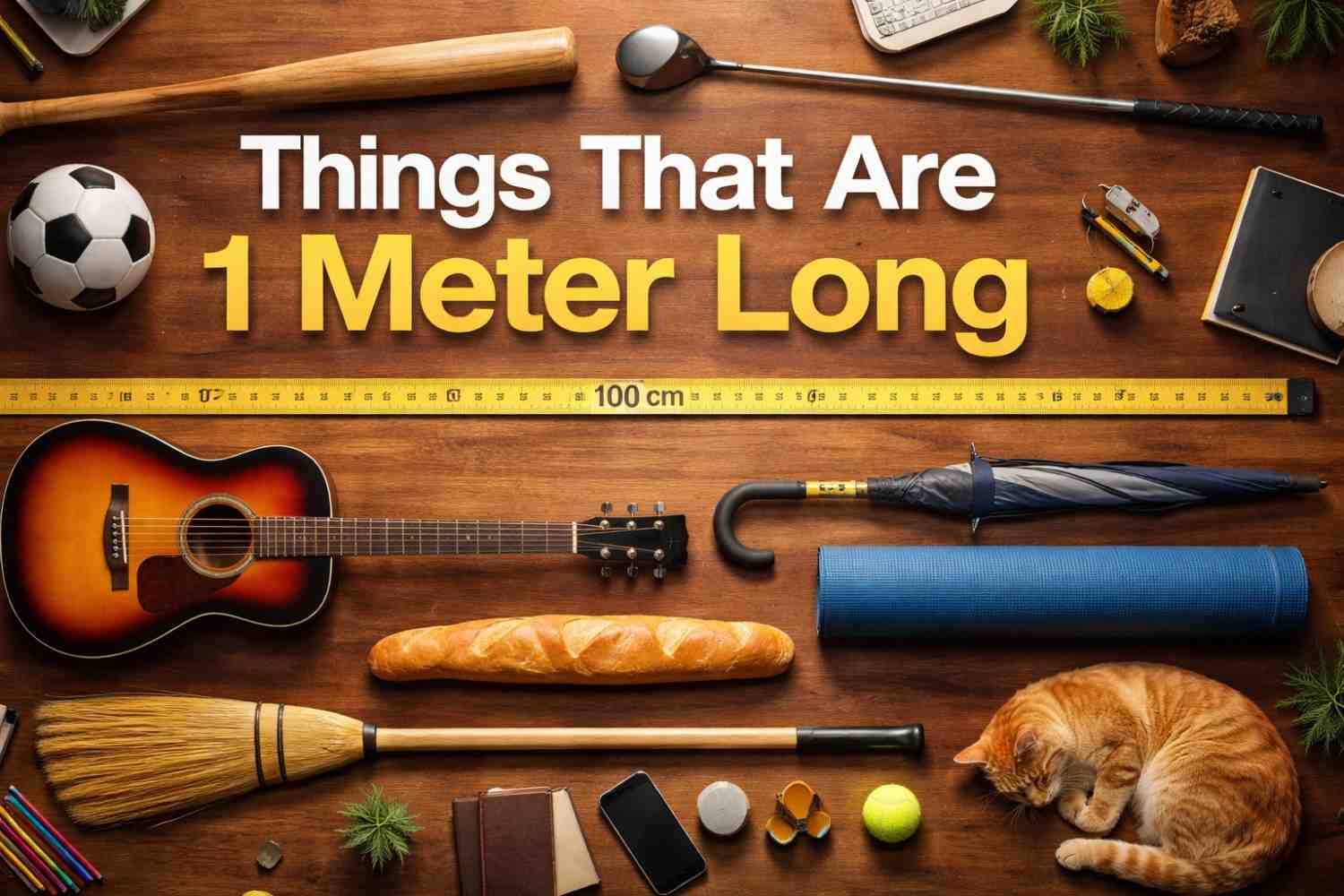
A meter sounds simple—just one unit of length. But it shows up everywhere. From sports gear to furniture, “1 meter” is a handy size people use to measure everyday things.
One meter equals about 39.37 inches or a little over 3 feet. It’s long enough to make a difference but short enough to handle easily. When people think in meters, they picture things they can stretch their arm across or walk beside. It’s a practical length that helps us picture space, distance, and proportion.
Let’s look at some everyday items that are about a meter long and see what that really feels like in the real world.

1. Baseball Bat
A standard baseball bat used by adults is about 1 meter long—technically between 32 and 34 inches, depending on the player.
That’s just a bit under a full meter, but the size comparison works well. When you hold one upright, it reaches around your hip or waist, depending on your height. It’s easy to see why this length works: long enough to generate power, short enough to control.
If you’ve ever swung one, you know that a meter feels solid in your hands. It’s a length that balances strength with precision.

2. Yardstick
A yardstick is one of the simplest ways to picture a meter. A yard measures 36 inches, which is just a bit shorter than a full meter. The difference? Only about 3 centimeters.
When you lay a yardstick and a meter stick side by side, you can see that extra inch of length clearly. But for most people, they’re close enough to use interchangeably. Both give you a solid, easy-to-handle way to measure short distances, and both fit neatly in a drawer or hang on a wall.
So when you hear “one meter,” imagine holding a yardstick. You’ll be almost exactly right.

Find Out More: Things That Are 500 Feet Long
3. Walking Stick
A typical walking stick or trekking pole is about 1 meter long when adjusted for average height. Hikers often shorten or lengthen it slightly, but the one-meter mark hits the sweet spot.
It’s long enough to help with balance and support, yet short enough to handle easily on uneven terrain. Hold one beside you—it usually reaches your hip bone or waist.
That length works well for both comfort and stability. When you’re hiking uphill, that one-meter pole gives you just the right leverage to steady your step.

4. Doorway Width
Most standard doorways in homes are about 1 meter wide, or a little more. In many countries, a typical interior door measures 32 to 36 inches, which translates to roughly a meter.
That width makes sense—it’s wide enough for a person to pass through comfortably, even carrying something. It’s also easy to build around in most spaces.
If you stretch your arms out to your sides, you’ll feel that doorway span—it’s about the space between your hands if you bring your elbows slightly in. That’s what one meter feels like in architectural terms—open but not oversized.

5. Golf Driver
A golf driver, the longest club in most golfers’ bags, is about 1 meter long. Some are slightly longer, up to 45 inches, but the difference is minor.
That length gives the driver its reach and power. It lets golfers swing in a wide arc and hit the ball far down the fairway. If you stand it next to you, it’ll usually come up to your hip.
You can think of a golf driver as the sporty version of a meter stick—sleek, balanced, and built for control within that same span.

Explore This Topic: Things That Are 9 Feet Long
6. Big Human Step
A large step made by an adult covers roughly 1 meter. It’s not exact for everyone—some people stride longer or shorter—but it’s a good general rule.
Take a normal, comfortable step forward, and you’ll cover about 0.75 to 1 meter. A big step, where you stretch your leg a little more, lands almost perfectly at the one-meter mark.
That’s why runners, surveyors, and even soldiers use the “pace” as a natural measuring tool. It’s easy to remember because it’s built into how we move.

7. Kitchen Counter Height
Most kitchen counters are built to stand about 1 meter high—technically between 90 and 92 centimeters.
That height feels natural when you’re cooking, chopping vegetables, or washing dishes. You don’t have to hunch over or reach too high. It’s ergonomic, meaning it fits the body well.
Next time you’re in your kitchen, look at your countertop. That’s roughly one meter high. It’s one of those everyday measurements that just works.

8. Longsword
A medieval longsword—the kind you see in museums or historical shows—often measures close to 1 meter in total length. The blade alone might be around 85 to 95 centimeters, and the handle adds the rest.
That makes it easy to swing with both hands while keeping balance. Hold one upright, and it’ll reach from the floor to your hip or waist.
It’s interesting that even centuries ago, humans found one meter to be a practical working length—something strong enough for reach but not too heavy to control.

9. One Yard of Fabric
In sewing, a yard of fabric measures 36 inches, or just under 1 meter. When unrolled on a cutting table, it looks almost identical in length to a meter stick.
If you’ve ever bought fabric, that’s about the space it covers when spread flat. A meter or a yard gives you enough material for small projects—like a pillow cover, a scarf, or the front panel of a shirt.
In textile shops that use the metric system, “one meter of fabric” is a common purchase, offering nearly the same usable length as a yard in imperial terms.

Check This Out: Random Things That Are About 6 Inches Long
10. Meter Stick
And of course, the most obvious thing that’s one meter long—a meter stick.
It’s the standard tool for measuring in metric units, marked from 0 to 100 centimeters. It’s straight, sturdy, and precise. You’ll find them in classrooms, labs, and workshops everywhere.
Hold one, and you instantly understand what a meter feels like. It’s the literal reference for the entire system. Simple, practical, and universal.
Conclusion
A meter might seem abstract on paper, but in real life, it’s everywhere. It’s the swing of a baseball bat, the width of a doorway, the height of a counter, or the stride of your step.
It’s a length that fits naturally into human movement and design. Big enough to matter, small enough to handle. Once you start noticing, you’ll see it almost daily—in tools, furniture, sports gear, and even the way you walk.
So next time you hear someone say “about a meter,” you’ll know exactly what that feels like—roughly the length of a bat, a walking stick, or your next big step forward.
FAQ: Things That Are 1 Meter Long
1. What common objects are about 1 meter long?
Items like a baseball bat, walking stick, golf driver, and meter stick are all close to one meter in length.
2. How many feet is 1 meter?
One meter equals about 3.28 feet or 39.37 inches.
3. Is a yard the same as a meter?
Not exactly. A yard is slightly shorter—36 inches, while a meter is 39.37 inches.
4. How tall is a kitchen counter in meters?
Most kitchen counters stand around 0.9 to 1 meter high, depending on design.
5. What can I use to estimate 1 meter if I don’t have a ruler?
Stretch out your arm or take one big step forward. Either one will give you a length close to one meter.